



Reflections on the Mechanics and Awareness of Ballroom Dancing
By Tony Lee
Introduction
As a child I admired those who could dance well, especially the dancers seen on television and in theatre, such as Fred Astaire and Ginger Rogers.
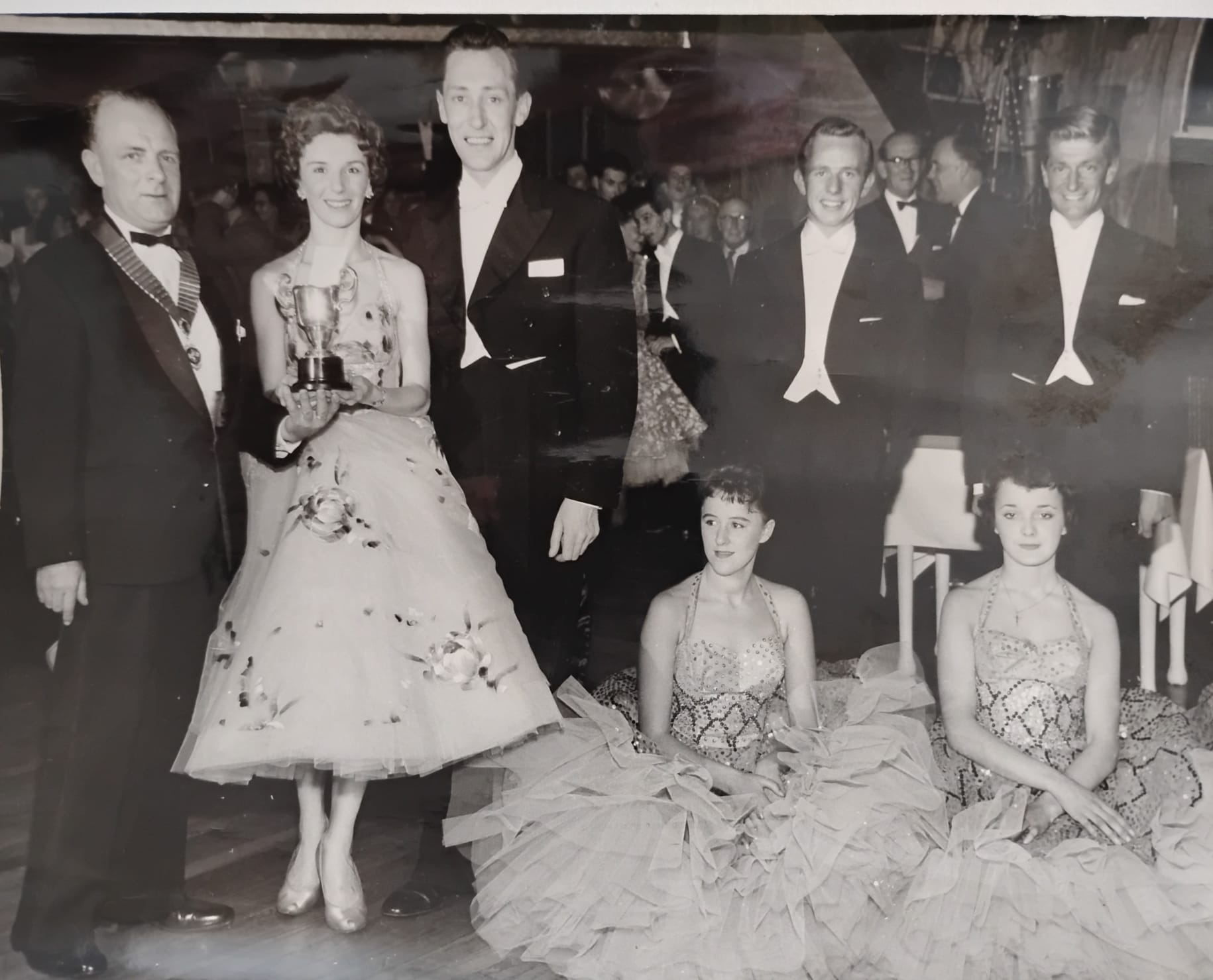
By what I would call a stroke of luck, I later met a couple who taught ballroom dancing, Denis and Doreen Murphy, originally from England. Denis first danced with his sister Edna in the late 1940s, and later with Doreen in the 1950s, whom he married. They placed well in many competitions and made finals in the Standard division at the Blackpool Dance Festival.

After a period of taking lessons and dancing with various partners, Denis once said to me:
“You are so light on your feet you will never understand how others cannot be like that.”
There are many, though. And that remark stayed with me. I began to wonder what he meant, and more importantly, how one might come to understand it.
I did take lessons from both Denis and Doreen, and I found it very valuable to have the perspective of both the man and the lady (leader and follower)
Language and Understanding in Dance
There are many words used to describe dancing, and often the challenge lies in understanding what is actually meant. Words such as flight, weight, compression, squeeze, centrifugal, heavy, light, and energy can all have multiple meanings depending on how they are used. When these words are used in a more colloquial way to describe what one feels, hears, or sees, misunderstandings can easily arise.
It seems to me that if the terminology used in dance were more precise – closer perhaps to the language of science – it might be easier to communicate ideas with less confusion.
Which brings us back to a central question:
How is it that some dancers are able to move so well – two people moving as one, to the music?
Weight, Force and Balance
Thinking about words, one that comes to mind is weight.
To be more precise, weight can be defined as mass multiplied by force. When one stands on a scale, what is being measured is the force of gravity acting on the mass of the body. That force can increase or decrease depending on how one uses the body—for example, by bending (flexion) or straightening (extension) the legs.
So the word weight may represent both:
- a noun (mass, which we possess), and
- a force (which we can become aware of through movement)
One of the dominant forces we contend with in balance is gravity. In a sense, we are always being pulled downward, while at the same time pushing upward into the surface we are standing on.
It is this continuous interaction that must be managed in dancing.
Awareness of Self and Partner
It seems to me that to dance well, one must develop an awareness not only of oneself, but also of the person one is dancing with.
The application of force has to be regulated, and balance over one’s base of support must be maintained as consistently as possible.
In ballroom dancing, particularly when contact between partners is desired, movement must be coordinated through an ever-changing body shape.
In the so-called “swing dances,” this includes:
- rising and lowering
- continuous rotation
- sway
These elements are present more or less at all times, with only very specific exceptions.
Human Balancing Systems
We as humans have several automatic systems that help us maintain balance.
One is the ocular-vestibular system, involving the eyes and the inner ear. The head can remain relatively stable while the body moves, as the eyes fix on a point and the nervous system sends signals to the muscles to maintain orientation.
Another system is proprioception. We have sensors in our muscles, tendons, and joints that provide information about where we are in space and time, allowing us to remain balanced over our base of support.
There are also cutaneous receptors in the skin, which can detect pressure and touch – whether it is a light contact or something stronger.
If one is healthy, these systems work together automatically and simultaneously. Through repetition and practice, they can be refined, leading into what is often called kinesthesia – the ability to move in a controlled and efficient way.
Flexibility and Efficient Movement
Flexibility of the body is essential for producing efficient and balanced movement.
Even in something as simple as walking, every joint in the body is involved. The body must move from foot to foot without sudden increases in force that cannot be absorbed, otherwise balance is lost or injury may occur.
Dancing is no different in that respect, although the way the body is used is more complex.
The amounts of:
- rising and lowering
- sway
- rotation of the pelvis over the femur
- turn over a standing foot
- twisting and bending of the spine
…all have to be regulated and coordinated, often to a much greater degree.
It seems that one of the more efficient ways to use the body is through sequential muscular action.
Figure 1 – Sequence of Lowering and Rising
Lowering generally begins at the ball of the foot, followed by the ankle, then the knee, and finally the hip joint.
Rising occurs in the reverse order.
This sequencing allows forces to be absorbed and produced in a controlled and balanced manner.
Counter Body Movement (CBM)
The use of the hip joint – where the femur meets the pelvis – is essential, as this is where movements such as sway and rotation are initiated.
The technique book describes Counter Body Movement as moving the opposite side of the body toward the moving foot.
In practice, this can be understood as a coordinated action beginning in the pelvis. For example, when moving forward, one side of the pelvis rotates over the supporting leg, and this rotation continues through the spine.
Figure 2 – Counter Body Movement
CBM begins in the pelvis and travels upward through the spine, allowing the body to initiate movement efficiently and maintain balance during turns.
Shoulder Girdle and Use of the Arms
In order for the thoracic part of the spine to function effectively, the shoulder girdle must not be locked to the ribcage.
If the arms become stiff or rigid, they interfere with the natural coordination of movement and can disrupt balance and connection.
It is better that the arms are:
- toned
- responsive
- and flexible
rather than fixed.
Posture and Poise
Posture and poise are also essential. If one imagines a vertical line passing through the body, it may run from:
ear → shoulder → hip → knee → ankle
For ballroom dancing, this alignment shifts slightly forward toward the ball of the foot.
Figure 3 – Body Alignment and Forward Poise
A forward poise helps maintain connection with the partner and allows for more stable and efficient movement.
The body must be engaged, but not rigid. The torso can be thought of as a tube containing the organs; it requires support from the surrounding muscles without stiffness.
Pendulum Swing in Ballroom Dancing
Another term often used is “pendulum swing.”
An actual pendulum consists of a mass suspended from a fixed point. When released, it accelerates downward due to gravity, gaining momentum, and then rises again. In dancing, the situation is different, but related.
The body is supported by the legs and feet, and movement must be actively controlled. In order to produce a pendulum-like effect:
- one lowers in a controlled way, resisting gravity
- pushes from the supporting leg to create forward movement
- allows momentum to develop
This combination of controlled lowering and forward drive can produce the effect of swing, and at times a floating or hovering quality at the top of the rise.
Figure 4 – Pendulum Swing Concept
Controlled lowering creates momentum, which contributes to rise and forward movement, often giving the impression of a floating or hovering action.
Rotation as Angular Movement
Turning movements in dancing are produced through forces applied across the joints.
This can be understood as angular movement, when force is applied to a body eccentrically. The action is initiated at the base of support and continues upward through the body.
In this way, rotation develops through the coordinated transmission of force from the feet, through the legs and pelvis, and into the spine.
While rotation is sometimes described using terms such as centripetal force, it may be more useful to think in terms of how and where force is applied eccentrically to the body.
This perspective can help clarify how turns, pivots, and spins are generated and controlled.
Use of the Left Side in Partner Work
Another useful idea in partner dancing is the awareness of the left side of the body.
For example:
- when turning to the right, the left side of the body moves forward relative to the right
- when turning to the left, the left side moves backward relative to the right
Thinking in terms of the left side—such as “left side back” instead of “right side forward” – can help reduce excessive force and improve the quality of connection.
At times it may feel as though both partners are working with their left sides together, which can create a lighter and more coordinated movement.
Leading and Following
In partner dancing, the idea of leading and following is often discussed.
For the leader, leading may be understood as indicating a direction of movement using as little force as possible. It is not a matter of pushing or pulling, but rather of creating a pathway. The leader must also remain aware of the followers balance and position, adjusting as necessary.
At the same time, the follower must be able to move with confidence, without hesitation or anticipation.
If both partners move to the music and maintain their own balance, the movement becomes continuous and easier to sustain.
Final Thoughts
As in many athletic activities, balance is of great importance. One might say that form follows function, and that there is a certain beauty in balanced and efficient movement. The dancers who appear most effortless are often those who are best balanced.
At the same time, dance is more than mechanics. The dancers are interpreting and expressing something through movement to music.
How this is done may vary from person to person.
Not everyone processes or responds to information in the same way. Some may respond to technical explanations, others to more descriptive or feeling-based language.
It becomes a matter of finding the form of communication that best suits the individual.
These are simply a few thoughts, based on my own observations and experience.
Tony Lee
About the Author
Tony Lee, originally from Vancouver, Canada, began his ballroom dance training at Arthur Murray before continuing his studies in Ontario with renowned teachers Denis and Doreen Murphy. After early competitive experience, he shifted his focus toward a deeper understanding of balance, movement, and technique in partner dancing. His work reflects a strong interest in the mechanics of movement, musicality, and clear communication between partners.


